

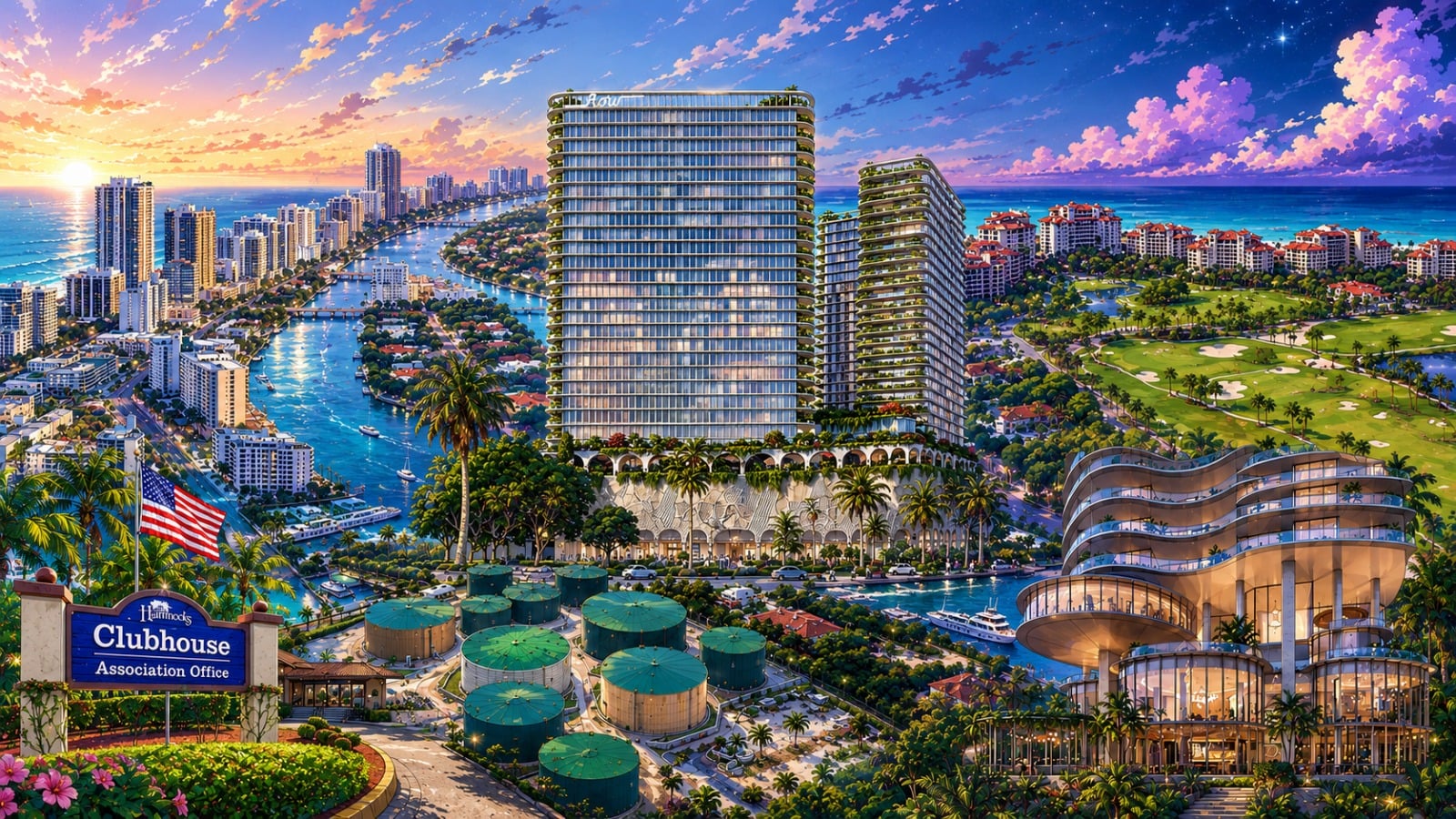
From a proposed Florida property tax cut and a high-stakes Fisher Island eminent domain battle to new branded luxury towers, major HOA fraud fallout, and large-scale residential proposals across Miami-Dade, June 2026 reflects a market still moving through rapid transformation.
Developers continue advancing ambitious condominium, rental, mixed-use, and branded residential projects, while policymakers and buyers are increasingly focused on affordability, taxes, governance, infrastructure, and long-term livability.
At the same time, Miami-Dade’s development map continues expanding beyond the traditional urban core, with new activity emerging in Miami Gardens, Aventura, and areas impacted by the Urban Development Boundary.
Here’s your curated look at eight major stories influencing South Florida’s residential, commercial, and development market this month.
Florida Property Tax Cut Backed by DeSantis Heads to November Ballot
Florida lawmakers approved a constitutional amendment on June 2 that would significantly expand the state’s homestead exemption, sending the proposal to voters for the November ballot.
If approved, the measure would increase the exemption from $50,000 to $150,000 in 2027 and then to $250,000 in 2028, potentially lowering annual property tax bills for primary homeowners across the state, including many Miami-Dade residents.
For South Florida buyers, the proposal comes at a time when insurance premiums, property taxes, mortgage rates, and affordability pressures remain major factors in purchase decisions. A larger exemption could make primary-residence ownership more attractive for certain buyers, especially those weighing monthly carrying costs in high-tax coastal markets.
Real estate analysts note that the measure could also influence buyer behavior by encouraging more end users to prioritize homesteaded properties, while potentially reshaping conversations around local government revenue, municipal budgets, and long-term housing affordability.
Miami-Dade Enacts Eminent Domain on Fisher Island Fuel Depot Serving PortMiami
Miami-Dade County is moving forward with eminent domain to seize the aging fuel facility on Fisher Island after negotiations with developer HRP Group reportedly collapsed over a $400 million asking price.
The facility plays a critical role in supplying fuel to PortMiami’s cruise operations, placing the dispute at the center of a larger conversation about infrastructure, redevelopment, public need, and one of Miami’s most exclusive residential enclaves.
The county’s decision disrupts HRP Group’s planned luxury condominium development for the site and has already triggered major political and administrative fallout, including the resignation of two top county officials, among them the PortMiami director.
For Fisher Island, the legal battle adds uncertainty to future redevelopment potential on one of South Florida’s most valuable and supply-constrained islands. The case also highlights the growing tension between private luxury development and essential public infrastructure as waterfront land becomes increasingly scarce across Miami-Dade.
619 Brickell by Nobu Officially Launches Sales with Over $1 Billion in Reservations
13th Floor Investments and Key International officially launched sales for 619 Brickell by Nobu, a planned 75-story luxury tower with 296 residences on Brickell Avenue.
The project marks the first Nobu-branded residential building in South Florida and is being designed by Foster + Partners, with a lifestyle and wellness program positioned around the hospitality brand’s global identity.
Residences are expected to range from approximately $3 million to more than $60 million for penthouses, with pricing reportedly averaging between $2,500 and $2,700 per square foot. Developers are planning to convert reservations into contracts this summer after securing more than $1 billion in reservations.
The tower’s amenity package includes a $25 million wellness program with services such as cryotherapy, hyperbaric oxygen therapy, longevity concierge offerings, and hospitality-driven experiences designed for ultra-luxury buyers.
The launch reinforces Brickell’s position as one of the strongest branded residential corridors in South Florida, where global hospitality names continue competing for luxury buyers seeking service, exclusivity, and prime urban waterfront access.
Is South Florida’s Branded Condo Boom Reaching Its Limit?
The Real Deal’s June 2026 magazine examines whether South Florida’s wave of hotel-branded condominium projects is approaching a saturation point.
Miami’s current branded residential pipeline includes high-profile names such as Nobu, Dolce and Gabbana, Waldorf Astoria, Delano, and other hospitality-backed projects that are reshaping the luxury development landscape.
While branded residences continue attracting buyers seeking service, design, and lifestyle alignment, some buyers are beginning to question whether the brand premium is justified across every project.
PMG’s Kevin Maloney, speaking at the National Association of Real Estate Editors conference in downtown Miami, acknowledged that not all branded projects are built equally, even as PMG’s Delano Residences reportedly surpassed 30 percent presold only months after launch.
The discussion reflects a broader shift in the luxury market. Buyers are still responding to trusted hospitality brands, but they are also becoming more selective about location, architecture, service quality, developer track record, and the long-term value behind the name.
The Hammocks: Inside South Florida’s Largest Known HOA Fraud
A deep-dive investigation into The Hammocks homeowners association revealed one of South Florida’s largest known HOA fraud cases, exposing serious governance failures within one of Miami-Dade’s biggest residential communities.
Former HOA president Marglli Gallego was sentenced to seven years in state prison after a years-long scheme that drained more than $11 million from the community.
The investigation detailed allegations that included invalidating 1,900 recall signatures and raising annual assessments by 167 percent, creating major financial strain for homeowners and raising broader concerns about board oversight.
For South Florida buyers, the case underscores the importance of reviewing HOA and condominium governance before purchasing. Financial statements, reserves, board history, litigation, assessment trends, and meeting records can be just as important as price, location, and property condition.
As condo and HOA scrutiny increases across Florida, especially after recent insurance and reserve law changes, The Hammocks case serves as a reminder that strong governance remains one of the most important forms of protection for homeowners.
Large-Scale Mixed-Use Development with Affordable Units Proposed in Miami Gardens
Landmark QOZB Construction filed a pre-application with Miami-Dade County to rezone a Miami Gardens site for a new mixed-use redevelopment.
The proposal calls for 190 affordable rental units along with approximately 24,000 square feet of retail and restaurant space, adding both housing and neighborhood-serving commercial uses to Miami-Dade’s northwest corridor.
The project is also tied to Opportunity Zone incentives, reflecting a broader effort to bring more investment into areas outside Miami’s traditional luxury development centers.
Miami Gardens has increasingly drawn attention from developers seeking more attainable land prices, larger development sites, and proximity to transportation corridors, employment centers, and growing residential demand.
If advanced, the project could contribute to the area’s long-term transition into a more mixed-use, mixed-income development market while addressing continued demand for affordable rental housing across Miami-Dade.
After Urban Development Boundary Expansion, Developer Proposes 773 Apartments in Miami-Dade
Infinity Gardens filed plans for a 773-unit mixed-use residential project in Miami-Dade County following one of the rare approved expansions of the region’s Urban Development Boundary.
The proposal marks one of the first major projects to take advantage of newly unlocked land previously restricted from dense residential development.
The project is significant because Urban Development Boundary expansions are closely watched in Miami-Dade, where growth management, environmental concerns, housing demand, and infrastructure capacity remain central planning issues.
Supporters of new development argue that additional housing supply is needed to address population growth and affordability pressures. Critics often raise concerns about sprawl, traffic, flooding, agricultural land loss, and pressure on public services.
For builders, buyers, and investors, the proposal signals where Miami-Dade’s next wave of residential growth could emerge as the county continues balancing density, affordability, land scarcity, and environmental planning.
WeWork Founder Adam Neumann Plans 720-Unit Flow Residential Towers at Aventura Business Park
Adam Neumann’s residential platform Flow filed plans for 720 apartments at an Aventura business park, marking one of the company’s largest planned South Florida footprints.
The proposal reflects Flow’s broader bet on live-work-community residential models that combine rental housing, shared amenities, lifestyle programming, and flexible community-oriented design.
The Aventura project also fits into a larger Miami-Dade trend of rethinking underperforming commercial and office properties as higher-density residential communities.
As demand for rental housing remains strong, developers are increasingly targeting sites with existing infrastructure, strong regional access, and proximity to employment, shopping, and transit corridors.
For Aventura, the project could represent a meaningful shift in how traditional business park sites evolve, especially as suburban and urban-edge locations become more attractive for renters seeking convenience, amenities, and access to both Miami and Broward County.
South Florida Real Estate Continues Evolving
From proposed property tax relief and HOA governance concerns to luxury branded towers, eminent domain disputes, and major residential expansion, June 2026 highlights the increasingly complex forces shaping South Florida real estate.
Miami-Dade continues attracting global capital, major developers, hospitality brands, institutional investors, and large-scale residential proposals. At the same time, affordability, insurance costs, tax policy, public infrastructure, and community governance are becoming increasingly important to buyers and homeowners.
The market is no longer defined only by luxury condo launches and waterfront sales. It is also being shaped by policy decisions, land-use changes, public-private conflicts, and the growing need for more housing across a wider range of price points.
As South Florida continues expanding, the region’s future will depend not only on development momentum but also on how effectively it balances growth with affordability, transparency, infrastructure, and long-term livability.
Stay informed with our monthly newsletter featuring Miami real estate news, development updates, and neighborhood insights.