

Most Miami families pick the wrong neighborhood for genuinely right reasons.
They fall in love with a Pinecrest acre and never do the math on their daily commute. They buy into the Coral Gables walk-to-coffee lifestyle and then realize their kids are on a private-school path that would have been easier from the Pinecrest side. The reasons they give for the choice are real. They are just not the reasons that decide whether the house still fits five years in.
The Pinecrest vs Coral Gables call is not about which neighborhood is "better." Both rank near the top of South Florida for schools, safety, and long-run resale. It is about which one fits the way your family actually lives, five years from now, when the newness has worn off and the weekends have settled into their real pattern.
The families who end up happy in either neighborhood answer four questions honestly before they tour. Here is the honest side-by-side.
1: How much privacy and privacy does your family actually need?
This is the question that decides more Pinecrest versus Coral Gables calls than any other, and most buyers never ask it until they are standing in a yard.
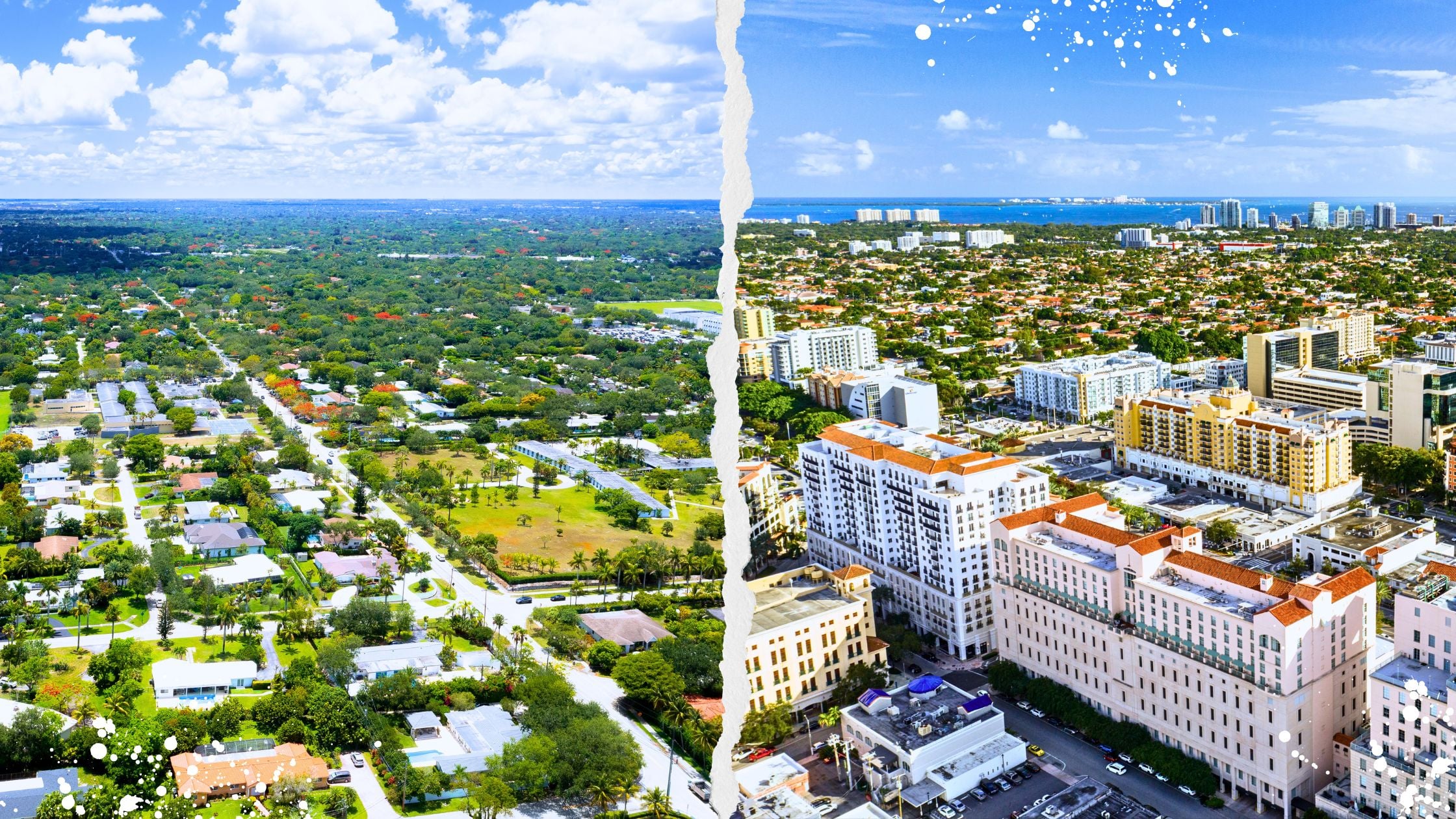
The Village of Pinecrest was built around large residential lots. The core single-family zoning here favors acreage, deep setbacks, and mature tree canopies. Pools are standard, driveways are long, and most homes have real buffer space between neighbors. If a family's weekend ideal is a backyard birthday party, a trampoline that does not share a fence line, and the dog running off-leash on its own grass, Pinecrest was built for exactly that.
Coral Gables has lots too, but the pattern is different. The historic core of the City of Coral Gables was planned around Mediterranean architecture, tighter grid blocks, and walkable scale. Large estates still exist in pockets like Gables Estates, Old Cutler Bay, Snapper Creek, and the Riviera section, but much of the city sits on quarter-acre to half-acre lots that feel more like a dense city neighborhood than a true suburb.
The honest cue: if the first thing your family mentions when touring is the yard, Pinecrest is probably the answer. If the first thing you notice is the street, the architecture, or the walk to a café, you are already in the Gables.
2: Which schools actually fit your kids' path?
Both neighborhoods sit in strong Miami-Dade County Public Schools attendance zones, but the school decision is not the same in each place.
Pinecrest families lean heavily on the public path. Palmetto Elementary, Palmetto Middle, and Miami Palmetto Senior High anchor the village's reputation, and families here often buy specifically for that zone. Private school commuters still exist, but the public pathway is the default assumption for most Pinecrest buyers, and homes inside the strongest attendance boundaries price accordingly.
Coral Gables is a split story. The public schools, including Sunset Elementary, Coral Gables Preparatory Academy, Ponce de Leon Middle, and Coral Gables Senior High, are strong, but the Gables also sits inside the densest private-school cluster in Miami-Dade. Carrollton, Gulliver Prep, Riviera Day, St. Theresa, and nearby Ransom Everglades change the calculation for families who are private-school committed. For families already on a private track, the Gables delivers the shortest commute to the most options.
The decision cue: public-track families often get more value in Pinecrest. Private-track families usually find the Gables easier to run day-to-day.
Verify current school grades against the Florida Department of Education school grades portal before making the final call. School zones and ratings move year to year.
3: How much does walkability actually matter to your day?
This is the question that quietly decides more of these calls than families expect, usually about eighteen months after closing.
Coral Gables is one of the few genuinely walkable residential neighborhoods in Miami-Dade. Miracle Mile, Giralda Plaza, Books and Books, the Biltmore, and dozens of restaurants and galleries are reachable on foot from most of the city's residential grid. The Gables was planned for this. For a Saturday morning that starts with a coffee walk and ends with kids at the Venetian Pool without starting the car, this is the neighborhood built for that life.
Pinecrest was built for the opposite. The village is car-first by design, with homes set back on large lots and most retail concentrated along the US-1 corridor and the Dadeland adjacency. Pinecrest Gardens functions as the civic heart, and families drive to it the way other neighborhoods walk to a park. That is not a flaw, it is the point. Pinecrest trades walkability for lot size, privacy, and quiet.
The honest cue: if your current life already revolves around walking to things, Pinecrest will feel like a bigger adjustment than you expect. If your current life already revolves around driving, the Gables will feel slower than you want.
4: How much does commute and daily rhythm actually matter?
The last question is the most practical, and it is where the wrong answer costs the most.
Coral Gables sits roughly 10 to 20 minutes from downtown Miami, Brickell, and the Health District in normal traffic, and about 15 to 25 minutes from Miami International Airport. If one or both earners commute into downtown, Brickell, or the airport, the Gables gives back an hour or more a day across two commutes.
Pinecrest sits roughly 25 to 40 minutes from downtown Miami and Brickell depending on time of day, and the US-1 and Palmetto Expressway corridors absorb most of that traffic. Pinecrest families usually weight the commute as a tradeoff they are making deliberately in exchange for lot size, school zone, and the quieter day-to-day rhythm.
For a remote worker, or for a household where one earner commutes north while the other goes to south Miami-Dade, Pinecrest's location can work beautifully. If both earners commute daily to Brickell or downtown, the math usually points back to the Gables.
Commute data worth checking against current conditions: Florida Department of Transportation traffic data and MIAMI Realtors monthly reports for current ZIP-level pricing on 33156 (Pinecrest) and 33134 / 33146 (Coral Gables).
Pinecrest vs Coral Gables at a glance
Dimension | Pinecrest | Coral Gables |
Typical lot pattern | Large, acreage-friendly, deep buffers | Mix of estate pockets and tighter historic grid lots |
Primary school path | Public-track default (Palmetto zone anchor) | Public plus dense private-school cluster |
Walkability | Car-first by design | Walkable from most residential blocks |
Commute to Brickell / Downtown | Roughly 25 to 40 minutes | Roughly 10 to 20 minutes |
Civic heart | Pinecrest Gardens, US-1 retail corridor | Miracle Mile, Giralda Plaza, Biltmore area |
Buyer profile that fits best | Yard-first, public-track, quiet daily rhythm | Walkable, mixed-school, shorter commute |
Numbers are directional and worth verifying against current ZIP-level data before writing an offer.
What this means for sellers in either neighborhood
Both neighborhoods have strong seller demand, but the two markets do not move in lockstep. Pinecrest tends to reward sellers who price for the specific attendance-zone premium their lot carries. Coral Gables rewards sellers who understand which sub-neighborhood their block sits in, because an estate in Gables Estates and a bungalow near Ponce de Leon Boulevard trade on completely different clocks.
For families weighing a move inside or between these two neighborhoods, a quick pricing gut-check with a free current-value benchmark on your current home is the first move worth making before shopping starts. It gives you a floor to plan around before you commit to the new zip code.
For a deeper read on how each market behaves, the dedicated Selling a Home in Pinecrest 2026 guide covers Pinecrest-specific pricing, and the Living in Coral Gables lifestyle and real estate guide covers the Gables day-to-day in detail.
Choosing between them
If you have read this far and the four questions still have not pointed to one answer, that usually means the family's answer is somewhere in between, and the right next move is a tour of both with those four questions in hand instead of a listing sheet.
For a broader read on how these two neighborhoods sit inside the full Miami landscape, start with Where Is the Best Place to Live in Miami and the sibling pieces Is Coconut Grove Worth the Hype and Best Neighborhoods in Miami for Safety and Schools.
For a real conversation about which one fits your family, download the Free Home Buyer Guide or reach out directly. The right answer is almost never the one families walk in expecting, and the honest version is worth the hour.
Check out this article next