

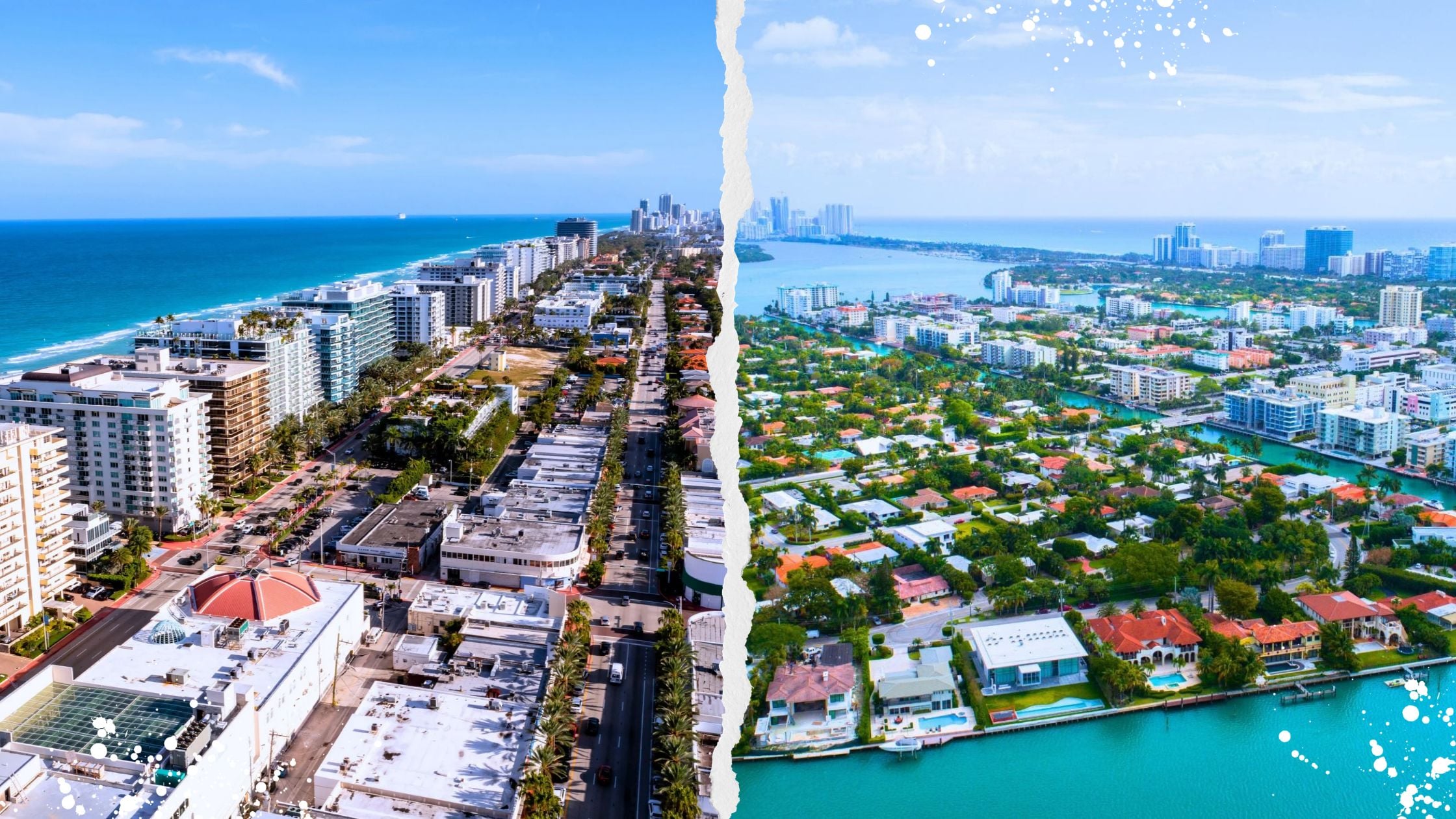
The Surfside vs Bay Harbor Islands question lands in my DMs almost every week, and it almost always comes from the same kind of buyer: someone who has already decided they want small village Miami Beach life and is now trying to figure out which of these two sand adjacent towns is actually theirs. The honest answer is these are not interchangeable neighborhoods. They sit about half a mile apart, share the 33154 zip code (which also covers Bal Harbour), and sell themselves on the same promise. The daily reality is very different. Here is how I break the choice down for clients in 2026, where the price per foot actually lands, and the one trade-off every buyer here signs up for without realizing it.
I live and work across Miami every day, and these two towns are two of the most under-explained markets on the beach. Most of what you will find online about Surfside and Bay Harbor Islands is written by people who have never had to tell a client why one listing is quietly more expensive to carry than another, even when the sticker says otherwise. That is the gap this piece is trying to close.
Two Villages, One Strip of Sand, Totally Different Days
Surfside sits on the barrier island north of Miami Beach, with the Atlantic to the east and Biscayne Bay to the west. Bay Harbor Islands is two man-made islands just across the Broad Causeway, bordered by water on every side but with no direct beach of its own. That one geographic fact drives most of the lifestyle difference between the two.
A Surfside day usually involves the sand. Residents walk to the beach, walk over to the Surfside Community Center, stop in at a Harding Avenue café, pick up groceries at the local Publix, and head home. The scale is still village: one main commercial strip on Harding Avenue, no high rise canyon, no mall. The pace is quiet in a way that feels unusual for anything on Collins Avenue north of Lincoln Road.
A Bay Harbor Islands day runs on a different axis. The village's main street is Kane Concourse, a tree lined boulevard that threads both islands and ends at the Bal Harbour Shops. Residents walk the Concourse, pick up coffee at one of a half dozen Kane spots, drop kids at the K-8 that sits in the middle of the island, and most of them never put sand in their car on the way home. The beach is a one minute drive away, which is close enough to use but not close enough to shape the day.
If you keep reading only one takeaway, keep that one. Surfside is a beach adjacent in the literal sense. Bay Harbor Islands is a village adjacent to the beach.
The Housing Stock: Oceanfront Buildings vs. Walkable Mid-Rises
The second major difference is what you can actually buy in each.
Surfside's housing stock splits roughly three ways. The oceanfront is dominated by condo buildings, from older mid-century stock on Collins Avenue up to the Four Seasons Hotel and Residences at The Surf Club, with the price range to match. One block west of Collins you move into a grid of single family homes and small post-war duplexes, many of them teardown candidates in 2026. The commercial side of Harding adds a handful of boutique mid-rises and new construction townhouses. Lot sizes stay small. Trees stay few. The architecture is a mix of mid-century stock, teardowns, and new modern builds that often look out of scale next to the older bungalows.
Bay Harbor Islands flips the ratio. The housing stock is predominantly condo and townhouse mid-rises on the East Island (the one with Kane Concourse), with a quieter pocket of single family homes on the West Island. The buildings are mostly two to seven stories, which is where the "walkable" piece earns its keep — nothing in the village casts a long shadow, and the Concourse stays sunny all afternoon. Several new construction condo projects have been delivered in the last three years, and more are permitted. There is almost no beachfront product because there is no beach.
So the housing question sorts most buyers for you:
- Want a house with your own yard, within walking distance of the sand → Surfside, probably on 90th through 95th Street.
- Want an oceanfront condo at a village scale → Surfside, Collins Avenue.
- Want a walk-to-everything condo in a quiet mid-rise, with a school across the street → Bay Harbor Islands.
Price Per Foot in 2026: Where the Numbers Actually Land
Zip code 33154 covers Surfside, Bay Harbor Islands, and Bal Harbour together, so most of the pricing you see online is averaged across all three. The sub-market story is where the actual signal lives. Pull the current MIAMI Realtors monthly statistical report by sub-market for the figures you quote in a specific listing conversation. The directional pattern I see on the ground is consistent.
Surfside oceanfront condos run meaningfully higher per foot than Bay Harbor Islands mid-rise condos. The gap varies by building age, view, and reserve picture, so no single percentage carries across the market. The single family homes west of Collins in Surfside compete more directly with the single family stock on Bay Harbor's West Island, and in that bracket Surfside typically carries a modest premium for the beach walk.
Where buyers get surprised: the inland Bay Harbor Islands condos often beat Surfside oceanfront on carrying cost per foot, after you factor association reserves, special assessment history, and the current property tax picture. The 2006 finance background I brought into this business tells me to always run that math before the sticker price makes the decision for a buyer. More than once, the "cheaper" Surfside unit lost that match inside five minutes.
Quick comparison, at a glance (2026, directional):
Factor | Surfside | Bay Harbor Islands |
Direct beach access | Yes, walk from most of town | No, short drive required |
Dominant housing stock | Oceanfront condos + inland SFH | Mid-rise condos + island SFH |
Walkable main street | Harding Avenue, village scale | Kane Concourse, boulevard scale |
Public school on the island | No K-8 inside town limits | Yes, Ruth K. Broad K-8 Center |
Carrying cost per foot | Higher at oceanfront | Often lower for comparable condo |
Buyer profile fit | Daily beach, want the sand | Daily walk, don't need the sand |
Schools, Safety, and Day-to-Day Walkability
Bay Harbor Islands wins decisively on one specific attribute: the K-8. Ruth K. Broad Bay Harbor K-8 Center sits in the middle of the East Island and is one of the better-regarded public K-8 options inside 33154. For a buyer who weighs that attribute heavily, nothing on this strip of beach quite matches walkable access to that specific school from inside the town limits. Surfside residents who want a comparable public K-8 end up zoning or busing to one of several Miami-Dade options outside the town, and the specific zoning depends on the home's address. Always verify current school assignment and current performance ratings with Miami-Dade County Public Schools before writing an offer; ratings shift year over year. I cover the broader Miami picture on this in Best Neighborhoods in Miami for Safety and Schools.
Walkability is a wash in a different way. Both villages are rated as highly walkable inside their own borders. Where they diverge is what you walk to. Surfside is walking to the beach, the Publix, and a short Harding Avenue strip. Bay Harbor Islands is walking to the Concourse's restaurant and retail cluster and over the pedestrian bridge toward Bal Harbour Shops. If you want to run every errand on foot and never see a parking lot, Bay Harbor's compact two island footprint arguably delivers more variety on a shorter route. If you want to walk to the sand with a towel over your shoulder, nothing in Bay Harbor delivers that.
As for safety: both towns maintain their own municipal services and are generally considered among the quieter zip code pockets on the beach, but any specific crime comparison should come from each town's own public safety reporting rather than an aggregator. Pull current statistics from the Town of Surfside and the Town of Bay Harbor Islands before you take any single comparison online at face value.
Who Each Village Is Quietly Built For
After roughly a hundred conversations with buyers who were weighing these two villages, the sort usually comes down to three questions.
- Is the beach a daily thing or a weekend thing? Daily, Surfside. Weekend, either.
- Does your week revolve around a specific school assignment? If yes and that assignment is Ruth K. Broad, Bay Harbor Islands. If your school picture is private or flexible, both villages work.
- Do you want the main street in front of your door to feel like a village strip or a boulevard? Harding Avenue is a strip. Kane Concourse is a boulevard with a center median and shade. Different experiences on the same hundred yard walk.
For a buyer who is still toggling between the two, I usually walk them both villages in the same afternoon. The feel sorts the decision faster than the comps do. If you want help running that walk, reach out and I will build the day around what you actually need from the neighborhood.
For the broader context on how both villages fit the greater Miami picture, I would start with my neighborhood lifestyle guide, and if you want deeper reads on each village individually, see Living in Surfside Miami 2026 and Bay Harbor Islands: Walkable Shops, Top Schools and Community Feel.
When You're Ready, Let's Walk Both Villages
Both of these villages reward buyers who actually spend time in them before they put money down. If small village Miami Beach life is on your shortlist and you want a working opinion on which one is yours, get in touch and I will build the walk. One afternoon on Harding and one afternoon on Kane Concourse usually ends the debate before I have to pull a single comp.
Check out this article next
