

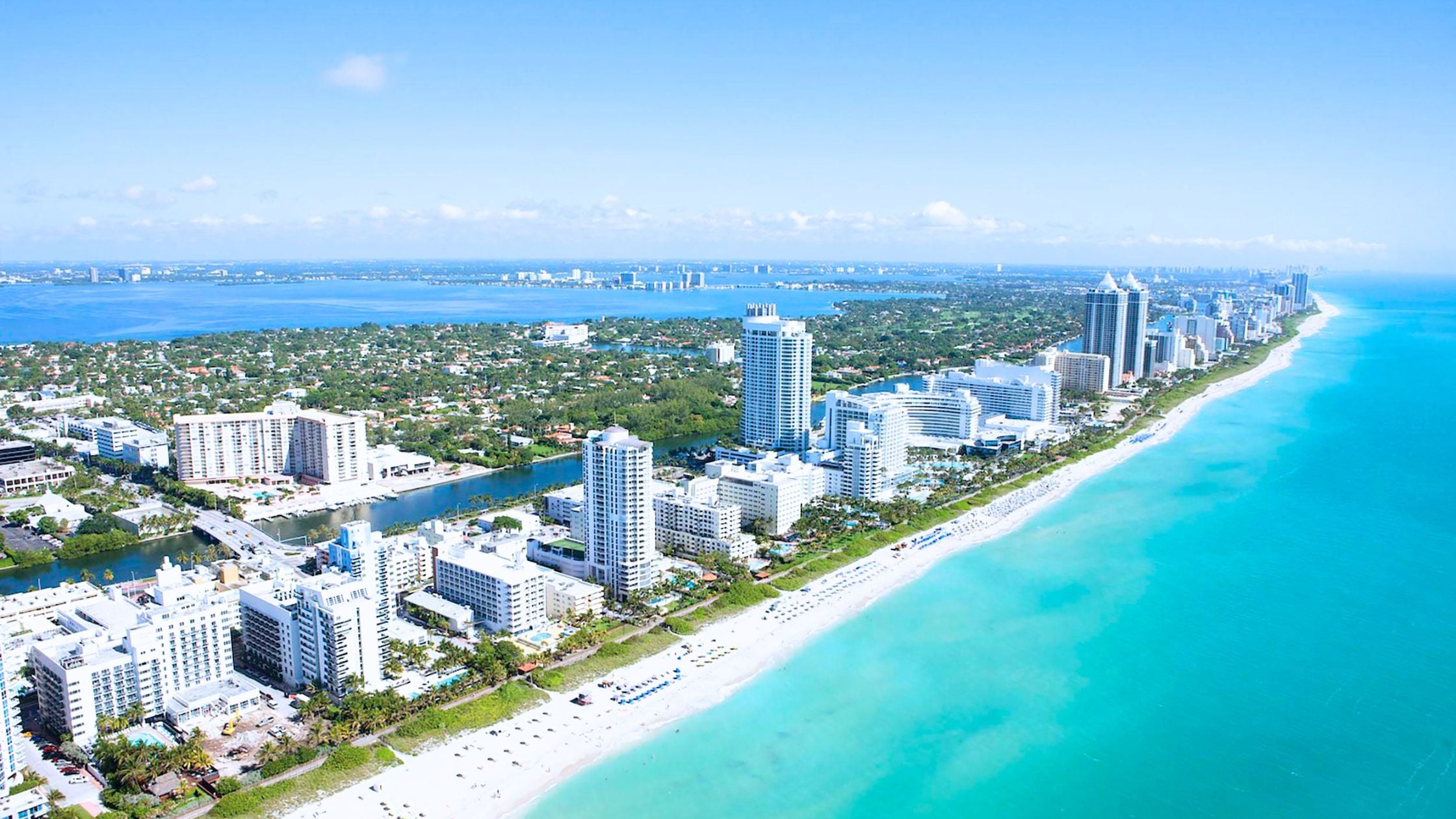
Miami Beach isn't one neighborhood. It's three, and buyers who treat the barrier island as a single market land in the wrong zip code almost every time. In almost every call I take from someone relocating to the Beach, the first ten minutes are spent untangling South Beach from Mid-Beach from North Beach. The names sound interchangeable. On the ground, South Beach vs. Mid-Beach vs. North Beach is three completely different housing stocks, three different nighttime maps, and three different pricing bands in 2026. Here is exactly where each one starts and ends, who tends to buy in each, how the pricing math actually compares right now, and the one trade-off nobody mentions until the house hunt is already underway.
Where each of the three Miami Beaches actually begins and ends
Most of the confusion starts with geography, so let me draw the lines before we get to anything else. These boundaries are the ones Miami Beach real estate and residents commonly use. The city itself does not publish a single codified South/Mid/North boundary map, so expect some soft edges block to block.
- South Beach: From South Pointe at the southern tip of the island up to roughly 23rd Street, with most of the buyer action between 5th Street and Lincoln Road. South of Fifth, or SoFi, is its own luxury pocket inside South Beach.
- Mid-Beach: From roughly 24th Street up to 63rd Street. This is the Collins Avenue tower corridor, the Faena District, the Fontainebleau, and the quieter residential blocks tucked behind the oceanfront buildings. Wikipedia breaks Mid-Beach into two subdistricts, Bayshore and Nautilus, and anchors it with the Collins Waterfront Architectural District.
- North Beach: From about 65th Street up to 87th Terrace at the Surfside border. North Shore Park, Normandy Isles, Biscayne Point, and the North Beach Community Redevelopment Agency district all sit inside this stretch.
The City of Miami Beach is one municipal government across all three, so your taxes and most of your ordinances read the same regardless of which zone you buy in. What changes block to block is zoning overlay, flood zone, building age, and the walkability of your daily routine. Flood exposure is a real factor on the Beach, and if that is new, my Miami flood zones explainer is a good first stop.
South Beach: Art Deco density, short holds, and the Beach's most liquid market
South Beach runs on tourism, 24-hour energy, and a visitor flow that most other Miami neighborhoods never see. Ocean Drive and Lincoln Road set the daytime rhythm. The housing stock reflects that, and it splits into three distinct layers.
The first is pre-war Art Deco. These are the pastel low-rises most people picture when they think "Miami Beach." Many are historic-districts protected under the City of Miami Beach planning and historic preservation framework, which locks in the architectural look and locks in some real renovation friction. The second layer is 1980s and 1990s mid-rise condo, which is the bulk of what's actively trading on MLS. The third is the modern SoFi towers, mostly south of 5th Street, where the trophy money has concentrated for the last decade.
What South Beach trades on in 2026 is liquidity. Hold periods are shorter here than anywhere else on the Beach. That cuts both ways. If you need to exit, you can. If you want long-term appreciation, you compete with pied-a-terre buyers who are not price-sensitive. My 2006 finance background makes me careful on this one, because short-term intent changes which loan structure actually fits. A 30-year conventional is rarely the right vehicle for a three-year South Beach hold.
Pricing in 2026 ranges widely inside this one neighborhood. Historic Art Deco studios still sit at the entry end of the Miami Beach ladder in the right buildings. SoFi oceanfront luxury sits at the top of the ladder in the trophy towers. That spread is a feature of South Beach, not a bug, and it tells you a lot about which segment of the market you're actually underwriting. For current numbers, I pull directly from the MIAMI Association of Realtors monthly statistical reports before every pricing conversation.
Mid-Beach: Resort-condo luxury and the quietest oceanfront on the Beach
If South Beach is the island's loudest zip code, Mid-Beach is the one that lets you sleep. The vibe is resort-residential. The Faena District, the Fontainebleau tower corridor, 1 Hotel Residences, and a Collins Avenue strip between 24th and 63rd stack high-end oceanfront condo against mid-century MiMo residential a block or two inland.
Housing stock in Mid-Beach breaks into two camps. The oceanfront towers are the headliners: Faena House, the Fontainebleau private residences, 1 Hotel Residences, and a long run of 1990s and 2000s branded and non-branded condos. Set back from the ocean, you still find 1950s MiMo single-family and small boutique condos on the quieter inland blocks. That inland strip is where buyers who want Beach access without full-time tourism tend to settle in.
Mid-Beach is the quietest full-service oceanfront on the barrier island. If you want to walk to a destination restaurant at the Faena but you don't want Ocean Drive foot traffic outside your lobby, this is the zip code. The trade-off is less density of daily services. You drive or ride more between errands than you would from a South Beach address.
For long-term appreciation, Mid-Beach's full-time primary-residence ratio runs higher than South Beach's, which tends to stabilize value. Pricing in 2026 is not cheap. Collins corridor trophy inventory sits near the top of the Miami Beach price ladder, and inland MiMo single-family has moved well past most first-time Beach buyers' opening budget. For a mainland comparison on bayfront luxury at a similar tier, my best waterfront neighborhoods piece is a useful reference.
North Beach: 1940s MiMo single-family, surf culture, and the Beach's last relative value
North Beach is where I spend the most time with buyers who want a beach lifestyle without Beach pricing. It isn't cheap. It's just the only stretch of Miami Beach where you still find full-time-resident density, 1940s and 1950s MiMo single-family homes on walkable blocks, and a daily rhythm that reads more like a neighborhood than a destination.
The housing stock is the real differentiator. Normandy Isles sits on a small island inside North Beach with its own canal network and a tight single-family grid. North Shore has mid-rise condo lining the oceanfront and smaller rental and condo stock inland. Biscayne Point and Stillwater carry single-family on cul-de-sacs with water frontage that still prices under equivalent product on the Venetian Islands, which I walked through here.
The North Beach Community Redevelopment Agency is the storyline buyers should actually know about. The agency was established in 2021 with a 30-year charter through 2051. A 5-year strategic plan was out for public review in October 2026, and the Ocean Terrace Park project is in the pipeline as part of the broader North Beach reinvestment. I'm not promising a specific outcome, since municipal plans move slowly and specifics shift. I am saying this stretch is the one on the Beach where discovery-stage buyers can still get in before a visible catalyst.
2026 price per foot in North Beach has moved up with the rest of Miami, but still trails South Beach and Mid-Beach on comparable condo and single-family product. For buyers who want to actually live on the Beach rather than visit, this is where my shortlist usually ends. For broader orientation on how it fits inside the Miami picture overall, my best place to live in Miami pillar is the right next stop.
The 2026 trade-off nobody tells you until the offer stage
Here is the one that catches buyers after offer, regardless of which Beach they choose. Under the Florida Senate Bill 4D legislation that followed the Surfside collapse, condominium buildings three stories and above now carry a milestone inspection and a reserve-study requirement. For coastal buildings within three miles of the coastline (which covers all of Miami Beach), the milestone inspection is triggered at 25 years from the certificate of occupancy, not 30. Buildings whose certificate of occupancy was issued on or before July 1, 1992 were required to complete the initial inspection by December 31, 2024, and the inspection repeats every 10 years after.
The practical result is that special-assessment risk and HOA-fee trajectories are uneven across the three zones. South Beach has the oldest condo stock on the island. Mid-Beach concentrates the most tower density. North Beach has a mix. Before you put down a deposit anywhere on the Beach in 2026, I'd ask three questions of the HOA: when is the milestone inspection due or complete, when was the last reserve study updated, and what is the proposed assessment schedule attached to it. The answer separates a predictable monthly carrying cost from one that can double after you close. For a mainland bayfront reference point if the Beach starts to feel heavy, my Edgewater guide is the natural cross-check, since that's where Beach buyers who want newer stock often end up looking next.
For the macro context, the NAR research hub is where I pull national buyer-composition and days-on-market data to pair with the MIAMI Realtors monthly reports linked above.
If Miami Beach is on your shortlist, let's talk
Picking between the three Miami Beaches is a decision that comes down to how you want to spend your Tuesday morning, not just which oceanfront view photographs well. I live and work in Miami every day, and I've placed buyers into all three zones this year. If this breakdown is useful, let's keep going. Reach out and tell me what your life on the Beach actually looks like, and I'll match the zip code to the lifestyle, not the other way around.
Check out this article next